Measure what persists through a branching region
Start with a finite module and a set of its labels that is connected by comparabilities and order convex, meaning that it contains every label between two of its labels. We will compute its generalized rank, the dimension of the common image of vector choices that agree under all the maps in that region. This example needs TamerOp and rational matrices; it does not need a filtration or graphics backend.
The two source lines below map into the same line in a common target plane. Their common persistent image has dimension one.
import TamerOp as OP
A = OP.Advanced
QQ = Rational{BigInt}
P = A.FinitePoset(Bool[1 0 1; 0 1 1; 0 0 1])
M = A.PModule{QQ}(P, [1, 1, 2],
    Dict((1, 3) => reshape(QQ[1, 0], 2, 1),
         (2, 3) => reshape(QQ[1, 0], 2, 1));
    field=OP.CoreModules.QQField())
region = [1, 2, 3]
A.check_generalized_rank_region(M; vertices=region, throw=true)
rank = OP.generalized_rank(M; vertices=region)
@assert rank == 1
Here vertices selects labels in the supplied finite poset. To ask about a region in an original parameter space, we would first need an encoding assignment describing how that space relates to these labels. [1,2] would be disconnected; on a longer chain, omitting a label between two selected labels would violate convexity.
The integer answers our question. To see how its compatible vectors pass to the common image, request the matrices as well. limit_basis stores compatible choices in the direct sum of the selected stalks; colimit_projection identifies vectors related by the maps. The comparison uses one stalk, the space at a selected label, to send a compatible choice to its common quotient class.
witness = OP.generalized_rank(M; vertices=region, witnesses=true)
@assert OP.generalized_rank(witness) == rank
comparison = A.comparison_map(witness)
@assert size(comparison) == (2, 1)
To see why this is a region question, replace the second map by the column QQ[0,1]. Both arrows still have rank one, but their image lines intersect only in zero, so the rank on the whole region becomes zero.
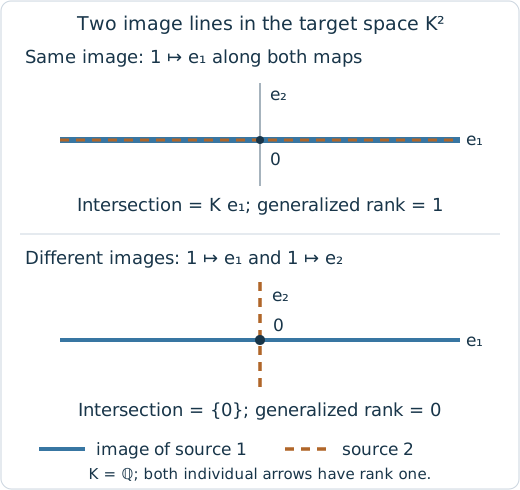
The upper plane is the supplied example. Replacing the second column by QQ[0,1] produces the lower plane and changes the common rank to zero.
The usage guide lets you compare these two forks and select one branch, keeping the matrices beside the chosen region. It then develops signed reconstruction, grid boundary barcodes and continuous worms. The implementation account explains the exact comparison; the region-view reference specifies linked selection and its budgets.