When does a module split into intervals?
In the two-square example, we built a module from two simpler modules. At a parameter covered by both squares its space has dimension two, and the maps across an overlap boundary tell us which coordinate continues. Suppose instead that someone gives us the spaces and maps without telling us how they were assembled. We would like to recover the pieces, even if a change of basis has mixed their coordinates.
Work first on the finite poset of an encoding. This keeps the algebraic question explicit, whether the original input was a filtration, a lattice presentation, a collection of geometric regions, or a directly supplied diagram.
A summand needs a way back
A submodule consists of a subspace at each vertex, with structure maps that carry these subspaces into one another. To recover it as a separate component of $M$, we need a module map $p:M\to S$ that reverses its inclusion $i:S\to M$: the equation $pi=1_S$ says that a vector returns unchanged. Such a map $p$ is a retraction, and $S$ is then a direct summand. Its kernel $R=\ker p$ supplies a complement, giving $M\cong S\oplus R$.
At each vertex, a vector $v$ separates as $ip(v)+(v-ip(v))$. The first term lies in the selected copy of $S$, and the second lies in $\ker p$ because $p(v-ip(v))=p(v)-pi(p(v))=0$. Since $i$ and $p$ commute with the structure maps, this separation is compatible across the whole diagram.
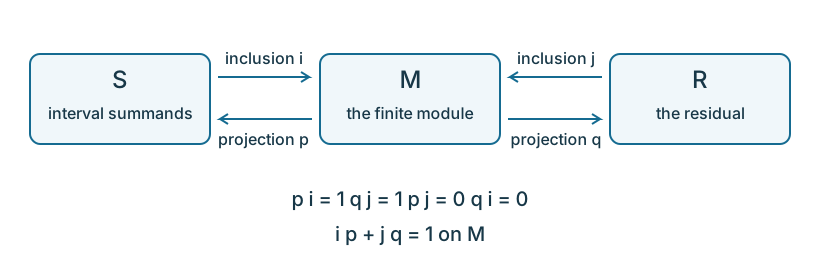
The two pieces are modules, not just separate subspaces at each vertex. Every displayed map must commute with the structure maps of the finite poset.
For a small obstruction, consider the identity arrow $k\to k$ on the chain $1<2$. The submodule $0\to k$ certainly exists. A projection onto it would be zero at vertex 1 and the identity at vertex 2. Those components do not commute with the arrow: one route gives the identity and the other gives zero. Thus this submodule does not split.
Which pieces count as intervals?
An interval $I$ in a finite poset is a nonempty connected, order-convex set. Connected means connected through comparable vertices, ignoring arrow directions. Order-convex means that $a,b\in I$ and $a\le z\le b$ force $z\in I$. An interval can branch; it need not be a rectangle or a totally ordered chain.
The interval module $k_I$ has one copy of the coefficient field $k$ at each vertex in $I$ and zero elsewhere. Maps inside $I$ are identities, and the other maps are zero. Convexity makes these maps consistent with composition. Connectedness means that an endomorphism, a module map from $k_I$ to itself, must multiply every nonzero stalk by the same scalar. In particular, $k_I$ is indecomposable: it cannot split into two nonzero modules. Otherwise projection onto either piece would be an idempotent other than zero or the identity, whereas a scalar satisfying $a^2=a$ in a field is either zero or one. Such a module is also called thin, meaning that every stalk has dimension at most one.
The interval multiplicity $m_I(M)$ is the number of copies of $k_I$ in a decomposition of $M$ into indecomposable modules. Equivalently, it is the largest $m$ for which $k_I^{\oplus m}$ is a direct summand. For finite-dimensional modules on a finite poset, the Krull–Schmidt theorem says that the indecomposable pieces are unique up to isomorphism and order, so these counts are well defined. This is the multiplicity problem studied by Asashiba and Liu.
On the square with arrows $1\to2$, $1\to3$, $2\to4$, $3\to4$, take $M=k_{\{1,2,3,4\}}\oplus k_{\{2,4\}}\oplus k_{\{4\}}^{\oplus2}$. Its dimensions are $(1,2,1,4)$. The three displayed supports have multiplicities $1,1,2$. A change of basis can mix those coordinates at each vertex, but cannot change the multiplicities. Inclusions and projections recover a splitting in the supplied coordinates; that choice of maps is generally not unique.
Reading a selection of summands
Select the edge interval and both copies at the sink in the square example. Together they contribute dimensions $(0,1,0,3)$, leaving the constant square with dimensions $(1,1,1,1)$. At vertex 4 the inclusion picks out a three-dimensional subspace of $k^4$, and the projection recovers its three coordinates. The same choices commute with all four arrows, which makes the selection a submodule with a complement.
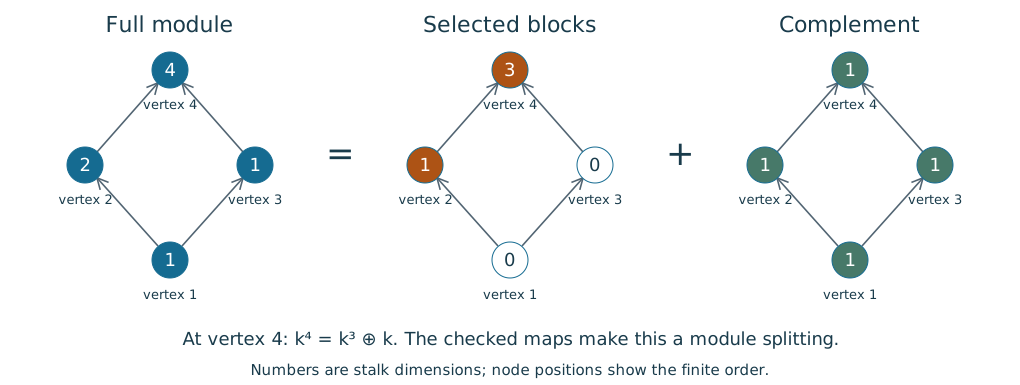
The dimension equality holds at every vertex. The inclusion and projection supply the compatible maps needed to turn these equalities into a splitting.
The prepared comparison in the guide lets you change the selected blocks while keeping the full module fixed. Follow the top vertex as the selection changes: the edge contributes one coordinate, the two copies at the top contribute two, and their complement accounts for the remaining coordinates.
If the module has an encoding map, assigning each original parameter its finite label, the preimage of a selected support gives the region where the piece is present. We can draw that region directly from the encoding. A support picture produced by an approximation procedure has its own accuracy question; the splitting maps alone give no information about the error in its boundary. For a piece whose stalk dimension varies, a dimension panel also records information that a uniformly colored support would omit.
A rank on a region asks a different question
Return to $k\xrightarrow{1}k$. Restricting to $I=\{2\}$ gives a one-dimensional space, so its generalized rank is 1. Its multiplicity as the ambient summand $k_{\{2\}}$ is 0. The incoming arrow, discarded by restriction, is exactly the obstruction to a retraction.
| Construction | What its numbers describe |
|---|---|
| Interval multiplicity | Copies of $k_I$ inside $M$, with a complement. |
| Generalized rank on $I$ | Compatible persistence through the restricted diagram. |
| Signed interval-family summary | Coefficients reconstructing specified rank queries on a declared family. |
| Matched slice tracks or support approximations | A chosen comparison or approximation, with its own guarantees. |
The last three do not by themselves give inclusion/projection maps for a splitting of $M$.
What can remain after every interval is removed?
Intervals do not exhaust the indecomposable modules of a general finite poset. Put $k$ at each of three incomparable sources and $k^2$ at their common sink, with image lines spanned by $(1,0)$, $(0,1)$ and $(1,1)$.
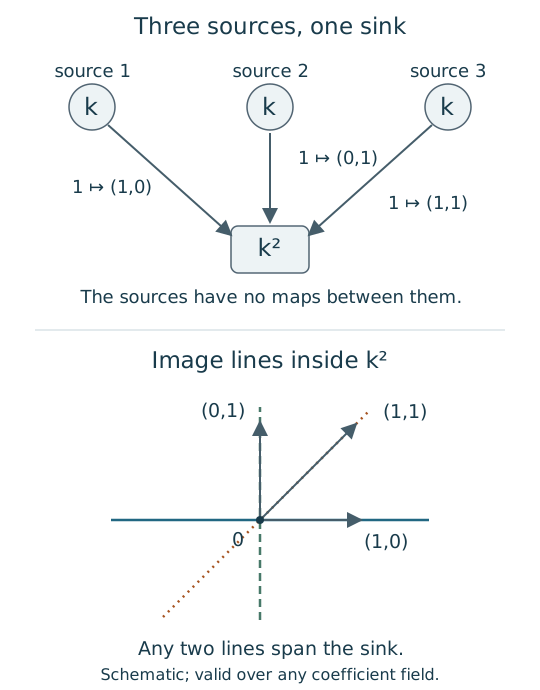
The upper diagram specifies the three maps. The lower is a schematic of their image lines in the common sink; the arrows mark the images of the source basis vectors. A projection that vanishes on any two of these lines must vanish on the whole sink.
This module has no interval summand. To retract onto a piece carrying one source, a functional at the sink would have to vanish on the other two lines, which span $k^2$. A piece carrying two or more sources would require their distinct image lines to lie in the same one-dimensional sink stalk. A piece supported only at the sink would require a functional vanishing on all three lines. Finally, a piece supported only at a source cannot be a submodule, since its outgoing map is nonzero. These possibilities exhaust the interval supports of this poset.
Every finite-dimensional module on this finite base has a maximal part that is a sum of interval modules, unique up to isomorphism, with a residual containing no interval summands. That residual can still split into several pieces that are not intervals. A complete interval search therefore answers interval-decomposability without solving general indecomposable decomposition. With only a chosen family, a nonzero residual leaves the global question open.
A splitting on an encoding's finite base pulls back along its classifier. Claiming that it is a complete decomposition in a larger ambient category requires additional comparison hypotheses. The finite answer alone does not supply them.
Continue with the computation
Compute interval multiplicities and inspect a splitting to see the square example in Julia, request actual maps, and compare a complete search with a chosen family.