Linked inspection sessions and browser execution
When we select a map in an encoded module, several parts of a figure help us understand the answer. The parameter picture locates its endpoints, the finite poset shows their labels, and a matrix describes the map in the stored bases. Those parts need to refer to the same selection, even while another query is being computed or a browser is waiting to draw it.
An inspection session keeps the selected question together with its prepared answer. Its snapshot is the complete static specification of that answer, including the panels, values and selected coordinates. A viewer draws this snapshot and follows later completed selections. Saving a view copies the prepared data, so the answer can remain available after the original Julia session has closed.
We will follow the square example from the usage guide, first through selection and reuse, then through browser updates and saving. The session reference gives the calling conventions; this account explains why the session retains particular data and when it has to compute again.
Retain the parameter question as well as its finite labels
An encoding consists of an order preserving map $\pi:P\to Q$ and a module $N$ on the finite poset $Q$. The module on the original parameter poset $P$ is recovered by reading $N$ through $\pi$. Thus the space, or stalk, at $x$ is $N(\pi(x))$, and a comparable pair $x\leq y$ has the structure map $N(\pi(x)\leq\pi(y))$. Write $q_x=\pi(x)$ for the finite label of $x$.
For the guide's module, $P=\mathbb R^2$ with the product order: both coordinates must increase for one parameter to precede another. The module is $\mathbb Q$ on the closed square $[0,2]^2$, zero outside, with identity maps between comparable parameters in the square. Its encoding assigns the interior of the square one finite label $q$. Consider
\[x=(1/2,3/2),\qquad y=(3/2,1/2).\]
These points have the same finite label, but the second coordinate decreases from $x$ to $y$, while the first decreases from $y$ to $x$. Neither point precedes the other. The finite module has an identity map at $q$, yet the original parameter order prescribes no map between $x$ and $y$. Asking for that parameter pair must retain this distinction.
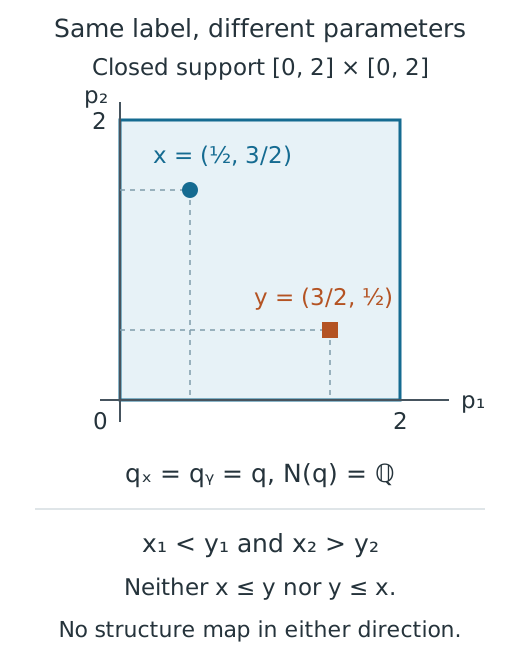
This schematic follows the same pair through its two descriptions. The finite label identifies the space at each point; the original coordinates determine whether there is a structure map between them.
The selected state therefore keeps the original query points and their order relation alongside the finite vertex or pair. It records which view was requested and whether the coordinates came from supplied numerical input or an approximate pointer position. A click near a boundary cannot silently become an exact claim about the boundary itself.
Other inspectors retain the identity needed for their own question. Several ordinary intervals may have equal endpoints and be drawn as one group. The group and the selected original member are both needed to recover a retained representative. An interval identifier in a slice belongs to that particular line; changing the line clears the interval selection. Likewise, the finite Hasse diagram, which draws the covering relations of $Q$, has schematic positions. Moving a drawn vertex would not change $\pi$ or the order on $P$.
Build a candidate before committing an update
A selection proceeds in private until its answer is ready. The session checks the requested domain, endpoints and options, prepares the selected algebra, and constructs the entire snapshot. Only after those steps succeed does it replace the current selection, snapshot and associated session cache entries. This replacement is the commit. A failed request leaves the previous answer available to every attached viewer.
For example, a successful move from an interior stalk to $(5/2,1)$ must replace the selected point, its finite label and the one dimensional stalk readout together: the new stalk is zero. Publishing only the marker while keeping the old algebra would briefly describe a different mathematical object. Preparing the snapshot before commit avoids that inconsistency.
A lock prevents two state changes from committing at once. During notification, the session also rejects a callback that tries to begin another update before the current notification finishes. A viewer can still fail while drawing an already committed answer; its error is recorded in a bounded list, and the valid mathematical selection remains in place. Several viewers may consequently finish drawing at different times, but each receives a complete snapshot.
The same arrangement applies to other questions without merging their mathematical meanings. A signed measure inspector prepares the selected sum and any supplied direct comparison. A spectral or chain inspector validates the page, index or vector with the corresponding mathematical operations. Those operations may maintain their own caches while preparing an answer; leaving the session unchanged after failure does not erase useful intermediate work owned elsewhere in the library.
Reuse the answer at the level where it remains valid
Finite module inspection prepares its geometry and layout once and keeps a bounded cache, a store of answers from earlier algebraic selections. A rank section fixes one finite label and retains the ranks of maps from it, or to it, rather than constructing a table for every pair of labels. Moving the selected parameter inside the same fiber of $\pi$ can reuse those finite ranks. The display must still check order in $P$ at the new point: the pair above has no map, even though its labels agree.
A slice session retains the module restricted to its current line. Choosing another barcode member can reuse that restriction; changing the line or changing between a finite window and the whole line requests a new one. A bar ending at the viewing boundary may be censored, meaning that the calculation stops there without determining the bar's true endpoint. It does not thereby become an essential interval, which persists indefinitely. The visual specifications account explains these endpoint conventions.
For a signed measure, a supplied direct callable evaluates the original observable at the selected query and smoothing choice. Changing the displayed term or view can keep that answer, while changing the query or smoothing must evaluate it again. Agreement between the signed sum and the direct value at one query supports that comparison; reuse does not extend it to every query.
Resource limits need to be interpreted at the operation they bound. A matrix crop limits the entries drawn, although constructing the selected map may require more work. A slice limit bounds the event strata used to calculate its ranks. Cache capacities bound the answers retained for reuse. Saving several snapshots has a further cost because each keeps the mathematical and graphical data needed to explain that selection.
Regions and their retained calculations
A generalized rank session asks how classes persist across a selected region. There are two supported domains. One is a set of finite labels that is connected through comparabilities and order convex: if it contains $a\leq b$, it contains every label between them. The other is a continuous closed worm in a positive two dimensional grid encoding, a square stretched along an anti-diagonal segment. The generalized rank and GRIL account defines that shape and derives the finite calculation of its rank.
The continuous query uses the grid encoding's specified extension: zero below either first coordinate, constant on each grid cell and constant along the upper tails. Selecting grid vertices inside a drawn polygon would generally ask a different question. The snapshot consequently retains the exact domain beside its rank; floating coordinates used to draw the worm do not replace the continuous restriction.
An encoding reaches this inspector through encoding_module. With a lazy encoding, whose finite module is constructed when needed, that call first constructs and caches the full finite module, including its maps. Query and drawing budgets are validated afterward, so they bound the selected computation and its drawing, not that initial construction. Later selections reuse the retained module.
Further calculations are explicit. A finite region can request matrices for its rank computation and, on a supported grid, a barcode along its boundary path. Choosing another occurrence or bar reuses that barcode, while changing the region clears selections whose identifiers belonged to the old path. For a worm, changing its width reuses the landscape at the same center and declared probe family; this landscape records widths at which specified rank levels persist. Choosing another displayed level reuses both the landscape and the current worm rank. Changing the center computes a new landscape. The session retains the current answer rather than an unlimited history of visited regions.
Exact coordinate entry and approximate pointer positions remain distinguishable. Hover reads retained values. Invalid domains, unsupported fields and exceeded budgets are rejected before commit, leaving the previous region and answer together on screen.
Linked coordinate sections
A sampled scalar field assigns a number to each point of a stored coordinate grid. A field session copies those samples and keeps one selected index on every coordinate axis. Each displayed plane varies its own two coordinates and fixes the others at that shared selected point. In three dimensions, for example, the $xy$ panel shows $f(x,y,z_0)$ while the $xz$ panel shows $f(x,y_0,z)$. Changing $z_0$ changes the samples shown in the first panel and moves the selected marker in the second, whose section still fixes $y_0$.
No invariant is recomputed during this navigation. Clicking a plane chooses the nearest stored sample on its two axes; it does not evaluate $f$ at an intermediate continuous coordinate. The sliders identify stored indices, and subtitles give the actual values of the coordinates held fixed. Multiple layers, such as sampled quantities in different degrees, have stable string identifiers. The default color range is computed across all supplied samples and layers, so selecting another layer preserves the comparison. An explicit range is retained as supplied. Changing the baseline or normalization prepares a new common scale.
As with module inspection, the complete candidate and snapshot are checked before they replace the previous state. Closing one WGL viewer removes its controls and event handlers. Closing the session releases the copied sample arrays and listeners while retaining the final snapshot, including copies of the selected planes. Those planes can be saved as static views. This inspector has no saved source reconstruction route for arbitrary new sections, and its live controls require Julia.
Several viewers can follow one session
The WGLMakie extension uses Makie to draw the figure and Bonito to exchange messages with the browser. Controls turn finite label choices, typed coordinates or pointer positions into the same selections available from Julia. Each viewer owns its controls, the handlers watching its scene, and its subscription to the session's completed updates. Several viewers can therefore follow one mathematical session while keeping their own canvases.
Removing a viewer releases those resources without closing the other viewers. Closing the shared session notifies all remaining clients, then releases its listeners, inputs, prepared navigation data and caches. The final static snapshot remains available even though further selections require a new session.
Live inspection depends on a running Julia process and a working connection to the browser. A direct Julia selection checks the mathematical transition; keyboard entry, pointer events, message delivery and closing a browser involve additional behavior. The display guide describes the available display modes, and the browser checking guide describes how those interactions are exercised.
Move a control while a query is running
Dragging a filtration cursor or slice handle can produce coordinates faster than their answers can be computed and drawn. The session keeps at most one executing request and one waiting request. A further movement replaces the waiting coordinates with the latest choice, so the queue does not grow with the duration of a drag. Until an answer commits, the visible snapshot still describes the preceding completed selection.
The worker prepares each answer on a private copy of the state and bounded session cache containers, sharing the mathematical input and prepared geometry as read only data. Before adopting the answer, it checks two counters. The request generation changes when a later gesture supersedes the request; the session revision changes when a direct selection has already replaced the visible state. Either change makes the private answer obsolete. Its snapshot and new session cache entries are then discarded.
Suppose a slow query starts for radius $r_1$ and the user moves on to $r_2$. Even if the first computation finishes successfully, its answer cannot commit once the new request has changed the generation. Similarly, an exact Julia selection made while that query runs changes the revision and protects its answer from the older browser request. This check concerns the state requested, not which calculation happens to finish last.
The worker briefly gathers a burst of events before beginning another query and yields to waiting tasks before the final check. It does not interrupt an algebraic operation already running. Closing a requesting viewer invalidates its work; closing the session cancels all its requests and releases the shared inputs after notification. A private calculation already underway may finish before its result is discarded. Mathematical owners can retain their own intermediate caches, as during a failed synchronous query.
Exact Apply controls for slices and connected complex controls use this worker as well. Inserting a WGL plot can require an acknowledgement from the browser. Doing that inside Bonito's incoming message callback would prevent the same task from receiving the acknowledgement. The queue lets the callback return before drawing starts. It preserves coordinates supplied through exact entry; direct selections from Julia remain synchronous.
The work performed by a request depends on the question. Selecting active cells compares their stored appearance grades with the parameter. A geometric viewer additionally computes its requested invariant. Its radius barcode depends on depth and can be reused while only radius or cell selection changes. An encoded module slice uses its bounded restriction cache and may calculate new ranks and intervals for a changed line. These operations use the retained filtration or module; they do not rebuild the source filtration or estimate a new density.
Keep drawing objects when the selection changes
A changed mathematical selection often leaves most of the drawing intact. The axes and colorbars of a coordinate section keep their meaning while its values and marker move. A selected matching pair changes highlighting within the same assignment. These viewers retain their figures and plot buffers, as do complex viewers when their source axes remain compatible.
The renderer first prepares drawing commands from the committed specification and compares their panel identities, coordinate planes, legends and shapes with the current drawing. Compatible commands change their arguments and attributes together through Makie's coordinated update API. Unchanged commands require no drawing update. If the declared coordinate limits stay the same, the axes preserve the reader's viewport and existing pointer handlers continue to refer to the same scene.
For a complex, a changed number of cells can require replacing plots on an existing axis; its limits and three dimensional camera can remain. A slice likewise keeps its barcode and diagram axes while interval counts and endpoint decorations change. Picking reads the current interval records. The interval axes follow the newly computed endpoint range, while the source view keeps its own coordinate frame. This avoids repeatedly creating browser canvases while older ones may still be waiting to initialize.
Consecutive planar cells with identical styling share a drawing primitive. Faces, edges and vertices retain their paint order, and a selected cell or a change to faint inactive context separates the groups. The picture can thus update a few polygon, path and point arrays while keeping individual cell identities for selection. Grouping drawing commands does not identify cells in the mathematical complex.
If the panel layout or contour legend changes, the renderer prepares a new figure offscreen and replaces the canvas once, then releases the old figure and handlers. A viewer whose browser has disconnected is disposed before further plot insertion; the other viewers can continue. Literal matrix layouts and composed figures use their own rendering paths. Each viewer retains one current drawing plan, with no shared scene cache or accumulated history of selections.
Reuse a declared atlas
An atlas displays a declared finite collection of parameter states together. Keeping their source pictures visible helps us compare changes in both parameter directions. Figure 1 of Loiseaux and Schreiber's multipers paper uses such a grid, while Figure 3 of Fersztand and Jendrysiak's Skyscraper paper relates a sampled bifiltration to its homology diagram. These are visual precedents; the atlas computes with TamerOp's homology and module map operations.
The caller supplies a list of states or a small coordinate grid. Construction prepares their spaces and all supported endpoint maps before the browser opens. For source complexes, the representative account explains the homology inclusions and optional cycles and fillings that witness a transition. Later choices of source, target, event and witness select among those retained answers without recomputing homology. An unavailable witness or invalid state index leaves the old selection in place. An incomparable pair is a valid selection, shown with no map; a comparable pair may instead have a defined map whose matrix is zero.
Each viewer keeps the grid of source pictures on one canvas, preserving the source coordinates, finite poset layout and cameras. Changing the selected transition replaces only its detail figure, which contains the matrix, cell entries or witness charts. Connected controls use the shared request worker so the browser can continue exchanging messages while WGL installs those plots. Hover reads the prepared labels and dimensions without requesting new work.
A saved atlas selection retains its grid of pictures, selected matrix, source cell records and witness coefficients. It has no request for reconstructing the live atlas input. The offline viewer can select another saved answer, but a new parameter query requires the original computation.
Editing and checking a mathematical draft
Editing an input raises a different question from selecting a result. Suppose we start with a diamond whose four stalks are $\mathbb Q$ and whose four cover maps are identities, then change the map $3\to4$ to multiplication by two. The editor should retain the changed entry so we can understand its failure. There are now two proposed answers for the map $1\to4$:
\[A_{24}A_{12}=[1],\qquad A_{34}A_{13}=[2].\]
Here $A_{ij}$ is the entered matrix from vertex $i$ to vertex $j$, with target coordinates indexing rows and source coordinates indexing columns. A module over the diamond must assign one map to $1\leq4$, so these two products must agree. The changed draft fails that condition.
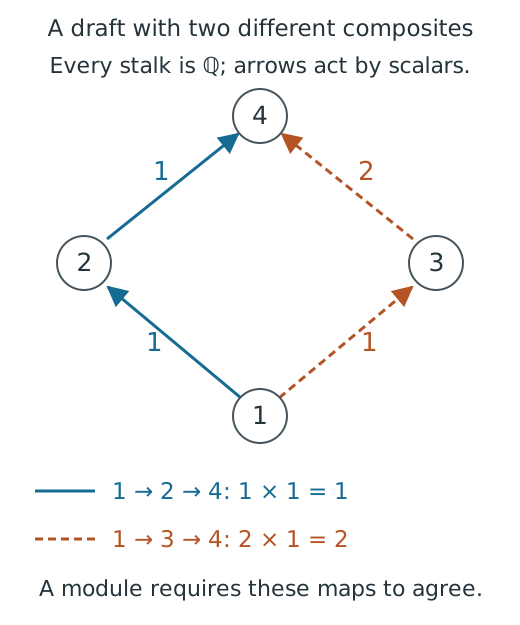
In this schematic, following the vector $1$ along the solid route gives $1$ at vertex 4, while the dashed route gives $2$. The editor keeps both paths and their actual composite matrices so the disagreement can be inspected.
ModuleEditorSession retains the entered numbers and a validation report. Constructing an ordinary PModule or finite FringeModule is a separate, checked export. The construction guide works through the diamond. An invalid mathematical draft is a useful editing state, while malformed input and exceeded budgets leave the old draft intact.
A module draft stores the full reflexive transitive relation, dimensions, and one matrix for each cover relation. A cover joins $i<j$ with no intermediate vertex. The editor checks the finite order, dimensions, cover coverage and matrix shapes before asking Modules.module_path_witness whether all paths agree. A fringe draft instead stores memberships in upsets and downsets, supports closed upwards and downwards in the finite order, with their coefficient matrix. FiniteFringe.check_fringe_data checks closure of those supports and permitted intersections; a selected stalk is the image of the active coefficient submatrix. The finite drawing supplies no additional assignment from ambient parameters.
The path check orders the vertices so each cover points forward, regardless of their numerical labels. For each source, it retains one path and its composite to every reached vertex. An alternative incoming edge extends an already checked prefix and compares the resulting product with the stored path. By induction along the ordering, once all prefixes into a vertex agree, checking every incoming extension establishes agreement of all paths to the next vertex. This handles routes of different lengths even when no elementary square exposes the conflict. In real fields the comparison uses the configured numerical tolerance; exact fields use equality.
No cached module composite supplies the diagnostic products. With $n$ vertices, $m$ covers and stalk dimension at most $d$, the traversal uses $O(nm)$ dense matrix products, each costing at most $O(d^3)$ field operations, in addition to validating the order and recording paths. Exact coefficient sizes affect the cost of those field operations. For each source it retains composite matrices of at most $d^2$ entries per reached vertex and explicit vertex paths. This is intended for bounded authoring; repeated map queries in a large valid module use their own caches.
Every edit normalizes and checks a fresh candidate, then prepares the snapshot before replacing the draft. Undo keeps a bounded sequence of preceding inputs and selections; a new edit clears redo. Selecting a vertex or edge creates no history entry, and Reset restores the initial input as an undoable edit. Changing a stalk dimension does not silently resize its adjacent matrices. Input limits on vertices, dimensions, entries and history are separate from the matrix crop shown in the figure. Revalidation currently constructs the small object anew; an incremental implementation would still have to check the full relations and preserve a conflicting path when they fail.
Browser entry uses labelled text tables and buttons. Coefficients are parsed as numeric literals, including an explicit matrix shape when a stalk has zero dimension. Julia export is generated from checked numbers; entered text is never evaluated. Saved snapshots retain the draft's typed data and its diagnostics. Reopening uses the ordinary editor constructor to validate it again and starts a fresh history. An invalid saved draft can therefore explain a failed relation without being accepted as a mathematical module.
Freeze data, then choose how it will reopen
visual_state copies the current snapshot, exact selection and a declarative request describing how a supported inspector was constructed. Later selections cannot rewrite that frame. Renderer objects, callbacks and runtime caches remain outside the saved record. Unsupported opaque metadata is listed as omitted, so a display label is not mistaken for recovered mathematical data. Style and figure size are separate save options: preserving a chosen palette requires passing that style when saving.
For a resumable frame, capture also calculates a content identity from the complete supported source. This fingerprint identifies the retained content, including mathematical data away from the currently selected map. Calculating it can construct a lazy finite module and validate its cover maps. A static specification can instead be captured with its selected data, without a reconstruction request or full source fingerprint:
visual_state(Advanced.inspection_snapshot(session);
    selection=Advanced.inspection_selection(session))
When saving an attached or referenced source, the library checks its identity against every resumable frame and replays the supported requests. The selected coordinates and prepared answer must agree with the frozen state. This adds query work, but catches an unrelated source whose currently selected matrix happens to look the same.
| Restoration | What is recovered | Work on reopening |
|---|---|---|
| Load a saved frame | The recorded snapshot and exact selection | Read the prepared answer; drawing it still costs rendering work |
| Resume a supported inspector | A new session from an included or checked referenced source and its request | Run the constructor and selected queries with fresh caches |
A closed inspector can still supply its static answer, though its released source cannot be recovered from that snapshot. Live restoration supports finite modules, supported encodings and ordinary persistence diagrams. Other families can retain portable snapshots without a reconstruction route. For an encoding, resuming a displayed matrix additionally requires its original finite module coordinates: an isomorphic module expressed in different bases could show a different matrix. The serialization account explains how those coordinates and referenced resources are preserved.
Offline interaction selects among prepared answers
HTML export renders every retained state to SVG with CairoMakie and embeds the drawings, session record, plotted values and a small program for selecting states. The browser changes the displayed image and its associated records. All module, persistence and geometry calculations have already happened. Download controls expose the selected SVG, exact plotted values and complete session JSON, while a URL fragment can identify a saved state.
The program updates the page from data text without executing metadata. Its script and style are identified by hashes in the page's content policy, and it needs no network resources. Without script execution the initial figure remains visible; switching states requires the bundled program. Including a mathematical source in the file makes it available to a supported Julia restoration, rather than adding Julia computation to the browser.
Annotations retain their recorded meaning. An authored arrow remains an authored explanation. A previously checked connector keeps its frozen coordinates and evidence status; reopening its picture does not recalculate a source certificate or establish a correspondence to a changed object.
Preparing a portable collection includes rendering each state, calculating complete source fingerprints for resumable captures, and checking attached sources and queries. Storage includes every retained specification and SVG. Switching among those states is inexpensive because their answers have already been prepared. A small collection of informative selections can therefore explain the result while leaving further exploration to Julia.
Implementation locations
| Concern | Source |
|---|---|
| Module selections, commits, reuse and closing | inspection_session.jl |
| Waiting browser requests and obsolete answers | inspection_requests.jl |
| Grade ranges, exact events and coordinates | filtration_controls.jl |
| Interval groups and retained members | inspection_intervals.jl |
| Signed query reuse | inspection_signed.jl |
| Region queries and linked coordinate sections | inspection_generalized_rank.jl, inspection_fields.jl |
| Draft checking, history and export | module_editor.jl, editor_export.jl |
| Capture, saved states and live reconstruction | saved_sessions.jl |
| Browser controls and subscriptions | visualization_wgl_inspection.jl |
| Continuous controls and canvas gestures | visualization_wgl_controls.jl, visualization_wgl_slices.jl |
| Reused drawing commands | visualization_makie_retained.jl |
| Portable SVG states, downloads and offline controls | session_html.jl |