Build and validate a small module from spaces and maps
Suppose four vector spaces form a diamond, with $1<2<4$ and $1<3<4$. We want their maps to define a module on this finite poset, so following either path from 1 to 4 must give the same linear map. This recipe enters four one dimensional rational spaces, finds a disagreement between the paths, and repairs the map that causes it.
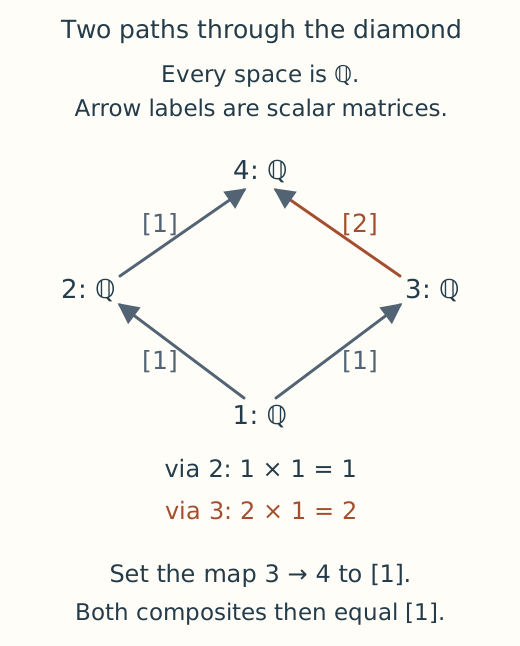
All four spaces are copies of the rational field. The arrows give the maps between adjacent labels. Starting with the scalar 1 at the bottom, the two routes currently give 1 and 2 at the top, so these data cannot yet define a module.
The input is already on a finite poset; we do not infer a filtration or an assignment from ambient parameters. The guide to constructing modules without a filtration explores those other starting points.
import TamerOp as OP
A = OP.Advanced
order = Bool[1 1 1 1; 0 1 0 1; 0 0 1 1; 0 0 0 1]
editor = OP.module_editor(; order, dimensions=ones(Int, 4),
    maps=Dict((1,2)=>[1;;], (1,3)=>[1;;], (2,4)=>[1;;], (3,4)=>[2;;]))
report = A.check_module_editor(editor)
@assert !report.valid
@assert report.witness.first_composite == [1;;]
@assert report.witness.second_composite == [2;;]
The order matrix records every comparison, including identities and $1\leq4$. The coefficient dictionary supplies only cover maps, meaning maps between comparable labels with no intervening label. Each matrix has one row per target coordinate and one column per source coordinate. Here the spaces each have dimension one, so the matrices are single coefficients.
The report shows why the draft fails: the two composites from 1 to 4 are $[1]$ and $[2]$. The editor keeps the draft so we can inspect and correct it, but editor_object will refuse to construct a module until the maps agree. Replace the map from 3 to 4 and check the resulting composite:
OP.edit_module!(editor; map=((3,4), [1;;]))
A.check_module_editor(editor; throw=true)
M = OP.editor_object(editor)
@assert A.structure_map(M; source=1, target=4) == [1;;]
Both paths now carry a scalar to itself. M is a PModule, the finite poset together with its spaces and compatible maps, ready for dimension queries, ranks and module algebra. It owns its data, so later edits to the draft leave this module unchanged. The editor contract explains field changes, undo and input limits.
For a computed static view, load CairoMakie and display OP.visualize(A.inspection_snapshot(editor)). With WGLMakie loaded, OP.visualize(editor; backend=:wglmakie) opens the live table editor, which needs Julia to remain running. The guide follows that workflow and constructs a module from an indicator presentation as another example.