Yoneda products and validated Tor algebra
An Ext group gives a space of extension classes. To multiply two compatible classes, we need to choose representatives, connect the resolutions on which they are defined, and express the composite modulo boundaries. Following those steps explains both the returned coordinates and the work that can be reused when several products are requested. Tor leads to a related question: what must supplied multiplication on chains satisfy before it determines multiplication on homology?
The inputs are representations of one finite poset over a coefficient field. The usage guide starts with the diamond directly; an encoding supplies the same setting through its stored finite module. These calculations remain in that finite category. Comparing their answer with Ext or Tor in another encoding or in an original parameter category requires the category and resolution hypotheses.
Lift before composing
Suppose we have modules $L,M,N$ and classes
\[\alpha\in\operatorname{Ext}^q(L,M),\qquad \beta\in\operatorname{Ext}^p(M,N).\]
Their Yoneda product $\beta\alpha$ belongs to $\operatorname{Ext}^{p+q}(L,N)$, with the left factor acting after the right factor. The relationship with splicing extension sequences is developed in the Stacks Project's treatment of Ext. TamerOp computes the class using projective resolutions, so it can return a representative without constructing all the modules of a spliced sequence.
Write $P_i(L)$ for the term in degree $i$ of a projective resolution of $L$. Each such term is a direct sum of principal projectives, stored by their vertex labels, and each differential is stored by a coefficient matrix. A map from the principal projective at a vertex $v$ to $M$ is determined by a vector of $M_v$. Thus a cochain $P_q(L)\to M$ can be stored as a concatenation of these stalk vectors, one block per projective summand. This representation avoids constructing a separate matrix at every vertex of the poset.
Let $a:P_q(L)\to M$ and $b:P_p(M)\to N$ be cocycles representing $\alpha$ and $\beta$. Their domains prevent us from composing them directly. First lift $a$ through the augmentation $P_0(M)\to M$. Projectivity of $P_q(L)$ makes this possible. Then extend the lift through the successive resolution terms, obtaining
\[F_i:P_{q+i}(L)\longrightarrow P_i(M),\qquad 0\leq i\leq p.\]
At each step, the preceding compatibility equation puts the required image in a kernel. Exactness identifies that kernel with an image, and projectivity allows the next lift. The resulting map $F_p$ has exactly the target needed for $bF_p$, a cocycle on $P_{p+q}(L)$.
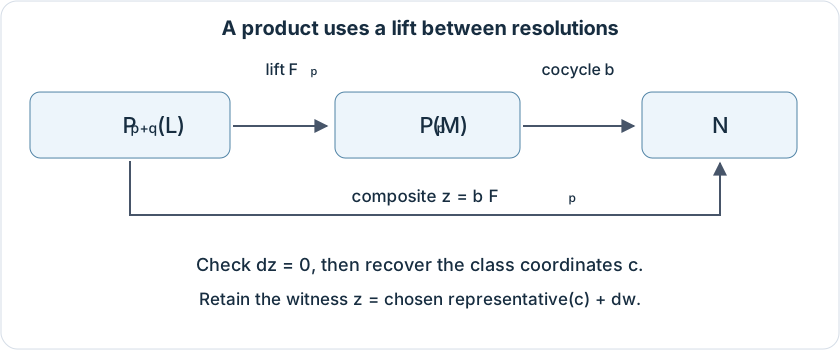
The right resolution must reach degree $p+q$, even though its selected class has degree $q$; the left model needs degree $p$. Before solving the lift equations, the calculation checks that the two descriptions of $M$ agree in field, indexed order, stalk coordinates and cover maps. Otherwise a vector in one description has no specified meaning in the other.
To form $bF_p$, the routine splits $b$ into its generator blocks. A nonzero coefficient of $F_p$ contributes a multiple of a structure map of $N$ applied to one such block. With at least eight nonzero lift coefficients, the current default accumulates these map applications into the output blocks directly. For smaller lifts, it prepares the required map matrices and then multiplies them by the blocks. Both routes concatenate the same cochain coordinates; the choice concerns how the intermediate structure maps are obtained. Quotient coordinates are then recovered using the shared linear algebra for the chosen field. The rational coordinate account explains the exact solves and membership checks used over $\mathbb Q$.
Fix the target coordinates
By default, the product is expressed using the right factor's resolution of $L$, now with Hom into $N$. A supplied ELN may instead choose another projective resolution of the same pair. The comparison must then go from the requested target resolution to the resolution used for composition: it lifts the identity of $L$, and precomposing with that lift transfers the cocycle into the requested Hom complex.
Consequently, both the returned coordinate vector and any requested cocycle belong to the returned target model. This matters when comparing two products: agreement of group dimensions alone would not identify their coordinates. No additional Koszul sign is inserted by this comparison convention; the signs in the differentials already enter the lift equations and the resulting coefficients.
For the bases used in the diamond example, the two products from the bottom simple through the middle simples to the top simple are nonzero and sum to zero in the same one-dimensional degree 2 group. The relation reflects the opposite coefficients of the final differential in the bottom simple's projective resolution. Over characteristic 2 those opposite coefficients are equal. This provides a small calculation in which keeping the maps and signs reveals something that the dimensions alone leave undetermined. The prepared product comparison keeps this common target basis while selecting either route or a zero factor.
The representative view retains a further check. For the composite cocycle $z$ and its quotient coordinates $c$, write $h(c)$ for the representative chosen by the result. The view solves for an incoming cochain $w$ satisfying
\[dz=0,\qquad [z]=c,\qquad z=h(c)+dw.\]
The last equation explains how the actual composite and the chosen representative determine the same class. The solution $w$ need not be canonical. When the product is zero, it witnesses that the composite is a boundary. Numerical fields use their recorded tolerances in these equations; a small floating residual has the meaning assigned by those tolerances rather than the force of a symbolic equality.
Reuse one table at a time
An ExtAlgebra retains a projective model of $\operatorname{Ext}^*(M,M)$. For a pair of degrees $p,q$, let $d_p,d_q,d_{p+q}$ be the dimensions of the three relevant groups. Its multiplication matrix has $d_{p+q}$ rows and $d_p d_q$ columns. Column $(i-1)d_q+j$ contains the coordinates of left basis vector $i$ multiplied by right basis vector $j$, so the matrix acts on kron(left,right).
The matrix form of yoneda_product computes selected collections of classes by lifting each right class once and composing it with every selected left class. These lifts last for that call. ExtAlgebra uses this operation on basis classes and retains the completed table for later requests in the same degree pair. Access to the table dictionary is synchronized so concurrent requests cannot corrupt it; the construction itself happens outside that lock. The resulting cached matrix is shared, so a caller must copy it before editing. A dimensions query neither populates this dictionary nor chooses quotient representatives.
The table alone stores $d_{p+q}d_p d_q$ coefficients, in addition to the resolutions and lifts. The visual request therefore checks the permitted number of input pairs and output entries before asking for multiplication. Cropping the displayed matrix happens afterward and does not reduce that work. When only one composition is needed, a selected :yoneda_product request computes it without building a complete self-Ext multiplication table.
Why Tor needs a supplied product
Incidence algebra Tor pairs a right module on the opposite poset with a left module. The resulting graded vector space has no multiplication determined by those two arbitrary modules alone. A TorAlgebra is therefore supplied with linear maps between chain spaces of the form
\[\mu_{p,q}:C_p\otimes C_q\longrightarrow C_{p+q},\]
where $C$ is the computed tensor complex. The column order is the same as for the Ext table: the right index varies fastest. A generator can supply these matrices as they are requested. If both source and target chain spaces are nonzero, a missing product is an error. A supplied unit is a homology class; it is not assumed to be a strict unit on every chain.
To obtain multiplication on homology, $\mu$ must send cycles to cycles and products involving a boundary to boundaries. Write $Z_p=B_p\oplus H_p$, where $Z_p$ is the cycle space, $B_p$ is the boundary space and $H_p$ is a chosen complementary space of homology representatives. Here $H_p$ denotes that chosen subspace of chains, rather than an independent canonical realization of homology.
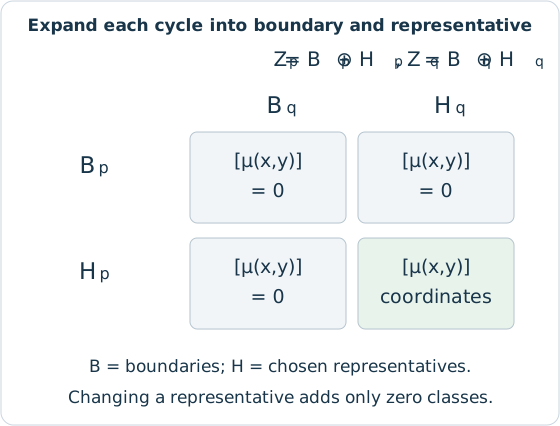
The diagram expands two cycles according to this decomposition. The implementation checks products of $B_p$ with all of $Z_q$, products of $H_p$ with $B_q$, and products of $H_p$ with $H_q$. The first two collections must have zero target homology coordinates, which checks both that they are cycles and that they are boundaries. The last collection must be cycles, so that their target coordinates exist.
Bilinearity explains why these checks suffice. Replacing cycle representatives $x,y$ by $x+b,y+c$, with $b,c$ boundaries, changes their product by $\mu(b,y)+\mu(x,c)+\mu(b,c)$. Every term on the right is a boundary by the checks above, so the resulting homology class is unchanged. Testing only products of the chosen representatives would miss this requirement. The boundary spaces include images from the extra degree above the displayed range, since those images can still change a class in the last shown degree.
Descent and algebra laws are separate checks
The preceding condition is called descent: a rule on representatives defines a rule on their quotient classes. It is required whenever a new Tor multiplication table is computed. Further algebraic laws are requested by check_tor_algebra(A; algebraic=true). One is the Leibniz identity,
\[\partial(xy)=(\partial x)y+(-1)^p x(\partial y),\qquad x\in C_p,\]
which says how a boundary interacts with the product. This is the homological version of the compatibility law in the definition of a differential graded algebra. The implementation checks its matrix form, including the additional incoming boundary degree needed by the computed range.
Associativity is checked on homology by comparing the two ways to multiply three classes for each computed degree triple. It does not demand strict associativity of the supplied chain multiplication. Both unit identities are checked when a unit class was supplied, and the report states the degree range covered by these checks.
The broader validation reads a consistent copy of the supplied multiplication data without filling the original algebra's product cache. Ordinary table computation also records which version of the supplied product it used. Before storing a result, it checks that the product has not been replaced through a setter in the meantime; an answer computed from older data cannot then be restored to the cache as current. A lazy generator must therefore remain stable until it is explicitly replaced and must permit concurrent calls. Changing state hidden inside the generator would evade this check.
Prepare mathematical data before drawing
The visualization routines consume the representatives and equations already prepared by these calculations. Ext keeps cohomological degrees, while Tor keeps homological labels and uses the reindexing $C^{-s}=C_s$ for shared complex inspection. A selected vector uses its result's existing quotient basis. Computing a fresh quotient merely for drawing could choose different coordinates and change what that vector meant.
A prepared specification copies coefficient matrices, retains their full sizes when the drawing is cropped, and records the finite base, field, model, degree and sign convention. Rendering places those records without performing further algebra. The visual specification account explains that separation and the export paths. An actual supplied exact sequence can be inspected in its own right; a product class is displayed through the representative obtained above.
See the implementation bibliography.