Compose a scalar background and signed changes
Suppose we have a table of dimensions and want to show which changes recover its entries by summation. We will use the square $[0,2)^2$: its dimension is one inside the square and zero elsewhere. The following calls place its signed changes over a gray background of sampled dimensions.
import TamerOp as OP
using CairoMakie

xs = [-1, 0, 1, 2, 3]
ys = [-1, 0, 1, 2, 3]
values = [Int(0 <= x < 2 && 0 <= y < 2) for x in xs, y in ys]
atoms = OP.SignedMeasures.point_signed_measure(values, (xs, ys))

context = OP.VisualContext(domain="square parameters",
    units=("x", "y"), provenance="square support formula")
background = OP.visual_panel(permutedims(values); x=xs, y=ys,
    quantity="dimension", context)
changes = OP.visual_panel(atoms; kind=:signed_atoms, context,
    limits=(x=(-1, 3), y=(-1, 3)))
overlay = OP.overlay_visuals((background=background, changes=changes);
    title="A square and its signed changes")
OP.visualize(overlay)
An atom is a point with a weight. Here the lower corner $(0,0)$ has weight $+1$, the corners $(2,0)$ and $(0,2)$ have weight $-1$, and $(2,2)$ has weight $+1$. To recover the dimension at $(x,y)$, sum the weights at points whose coordinates are at most $x$ and $y$. At $(1,1)$ only the first atom contributes, giving one. At $(2,1)$ the negative atom on the right has entered the sum and cancels it. Beyond both upper boundaries, the last positive atom corrects for subtracting the first contribution twice.
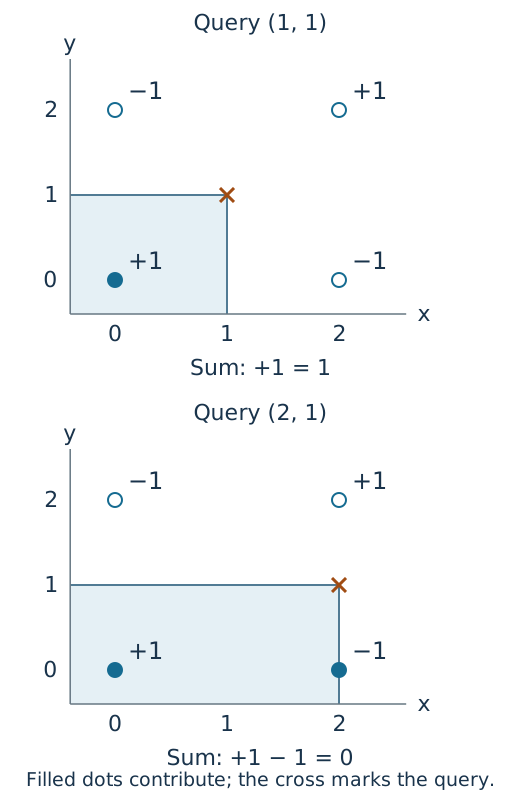
Each shaded rectangle selects atoms below the query in both coordinates. Its lower and left edges are cuts made by this schematic's viewing window; the mathematical sum includes all atoms below the query.
VisualContext records the common parameter domain, units and data description so composition can check that the panels agree. The table's first index is $x$, while rows of the plotted matrix follow $y$, which explains the permutedims call. The shaded cells in the computed background are centred on grid samples. Their edges are drawing conventions; the support's precise included and excluded boundaries come from the supplied square formula.
We can add an explanation at a chosen place in the figure by naming its panel and giving two endpoints in data coordinates. Here they bound a highlight of the square:
note = OP.VisualAnnotation(
    OP.VisualAnchor(:square; point=(0, 0)),
    OP.VisualAnchor(:square; point=(2, 2));
    kind=:highlight, label="The square support")
figure = OP.compose_visuals((square=overlay,); annotations=(note,),
    title="The square support and its dimension samples")
OP.visualize(figure)
The dashed highlight records an explanation we supplied. A solid connector has a more specific meaning when it comes from a checked computation: the composition guide connects a retained source cycle to its actual barcode interval and explains what that check establishes.
Save the selected figure as SVG for a document, or as HTML to open it in a browser:
OP.save_visual("figures", "square", figure; format=:svg)
OP.save_visual("figures", "square", figure; format=:html)
The HTML embeds the SVG and descriptions of its annotations. It can reopen without Julia or network access, with a scrollable figure at the saved size on narrow screens. The composition guide offers a cycle and interval figure in each export format to inspect or download. Each export preserves one selected picture. To save several selections and resume supported queries, continue with the saved session guide.
For a scalar field with more than two coordinates, first choose which two coordinates will vary and fix the others. The features guide uses ScalarField and field_session for that construction. The composition reference gives the compatibility conditions for combining the resulting panels.